Title: Indignation
Author: Philip Roth
Length: 233 pages
Year written: 2005
Why I chose this book: I bought this book on sale when Borders went out of business. It's been laying around for a few years.
Philip Roth is old. Apparently, he's quite the productive author as well. Indignation is third novel Roth released within three consecutive years. He wrote two more in the following two years, and nearly thirty in his entire career. Though this is the first novel of his that I've read, I can bet that many of the book's themes are personal to Roth and appear across his many works.
Indignation takes place in the early 1950s during the Korean War. The main character, college freshman Marcus Messner, is Jewish and overall quite the irritable and indignant (hey!) guy. His father's paranoia about Marcus getting into trouble or getting killed drive him away mentally and eventually physically, when he transfers to an out-of-state college to avoid his dad's overbearing behavior. At his new school, he finds multiple dorm arrangements to be intolerable, and ends up living alone in the worst room on campus. On top of all of this, he goes on a date with the campus nutbag, Olivia (who is a "goddess," but sports a scar on her wrist from an unsuccessful suicide attempt). His strange, stilted relationship with her seems to govern most of his actions thereafter, and for lack of better words (and to avoid revealing too much about the plot), it all spirals downward. I was reminded of the tragic movie The Butterfly Effect (featuring cinematic genius Ashton Kutcher) — as his dad warned him, every small misstep has the potential for tragic consequences.
Roth is funny, disgusting, and powerful as a writer. I'd definitely be interested to read some of his more famed works.
Rating: 8.5/10
Thursday, May 29, 2014
Wednesday, May 21, 2014
Book 13: Sanshiro by Natsume Soseki
Title: Sanshiro
Author: Natsume Soseki
Length: 228 pages
Year Written: 1908
Why I chose this book: I read somewhere that Haruki Murakami is a big fan of Natsume Soseki, and I was curious to know more about my inspiration's inspiration (in fact, Murakami wrote the introduction to this version of Sanshiro).
I did it again. I read a whole book, only to realize at the end that it is the first of a series. First of all, this book took me just over a month to finish (life has been a bit hectic). Secondly, the plot was so subtle that I can't really remember what happened. This 50 book challenge has really been a challenge of a new kind. Let me try to feel my way through this.
Sanshiro is about a 23-year-old guy who's just left a small community college in his rural hometown for a big university in Tokyo. He is the equivalent of a kid who's spent his whole life in Oklahoma and then heads for NYU. He is confused by the banter, the customs, and especially the women (this was written during a time, apparently, when women were like toy poodles and had to be escorted everywhere). He develops an intense crush on a woman named Mineko, who is coy, reserved, and yet bolder than any chick Sanshiro's ever encountered. The pace of the book is very slow, and really seems to spare no expense on setting the scene of Sanshiro's maiden voyage. Compared to Murakami's writing (which came several decades later), Soseki can seem a bit dry, but it does not deduct from the beauty and elegance of his storytelling technique. This book required a bit of patience, but at the least it was an ethereal experience.
Rating: 8/10
Author: Natsume Soseki
Length: 228 pages
Year Written: 1908
Why I chose this book: I read somewhere that Haruki Murakami is a big fan of Natsume Soseki, and I was curious to know more about my inspiration's inspiration (in fact, Murakami wrote the introduction to this version of Sanshiro).
I did it again. I read a whole book, only to realize at the end that it is the first of a series. First of all, this book took me just over a month to finish (life has been a bit hectic). Secondly, the plot was so subtle that I can't really remember what happened. This 50 book challenge has really been a challenge of a new kind. Let me try to feel my way through this.
Sanshiro is about a 23-year-old guy who's just left a small community college in his rural hometown for a big university in Tokyo. He is the equivalent of a kid who's spent his whole life in Oklahoma and then heads for NYU. He is confused by the banter, the customs, and especially the women (this was written during a time, apparently, when women were like toy poodles and had to be escorted everywhere). He develops an intense crush on a woman named Mineko, who is coy, reserved, and yet bolder than any chick Sanshiro's ever encountered. The pace of the book is very slow, and really seems to spare no expense on setting the scene of Sanshiro's maiden voyage. Compared to Murakami's writing (which came several decades later), Soseki can seem a bit dry, but it does not deduct from the beauty and elegance of his storytelling technique. This book required a bit of patience, but at the least it was an ethereal experience.
Rating: 8/10
Friday, April 18, 2014
Book 12: Memories of My Melancholy Whores by Gabriel Garcia Marquez
Title: Memories of My Melancholy Whores
Author: Gabriel Garcia Marquez
Length: 115 pages
Year Written: 2005
Why I chose this book: I bought this book as well as Love and Other Demons by Marquez a few years ago, and hadn't read either until recently. It was a very slim book, and I was intrigued to find out what level of storytelling he could accomplish in that number of pages.
One thing I always think about when I'm reading, without fail, is what was going through the author's mind when they chose that thought, that sentence, that idea. Memories of My Melancholy Whores is about an old bachelor deciding to celebrate the end of his run as an octogenarian with a virgin prostitute. Here enters 14-year-old "Delgadina" (he doesn't know, and doesn't want to know her real name). We don't hear directly from her the entire novel, but we are led to believe she fell just as deeply in love with the 90-year-old narrator as he did with her. However, it is the narrator's own assertion that he is prone to telling the same stories to friends over and over — and one can only imagine the credibility (or lack of) that such a fact lends to his perception and honesty in telling this tale. The narrator recounts moments throughout his life, mainly encounters with women that never coincided with romance or love. In Delgadina, he finally finds the elusive fuse in his heart and sets it aflame. While reading, I constantly wondered whether these were the diluted experiences of Marquez himself, and if not, how he dreamed up such a love story.
In our society, this storyline falls under the category of pure perversion. In different cultures, and throughout time, no one would bat an eye at what transpires between Delgadina and the old bachelor. It was very interesting to read this story from the most unbiased perspective I could adopt. In the few pages he wrote, Marquez tells a very tender tale of romance and awakening, if only on the narrator's behalf.
Rating: 7.9/10
Author: Gabriel Garcia Marquez
Length: 115 pages
Year Written: 2005
Why I chose this book: I bought this book as well as Love and Other Demons by Marquez a few years ago, and hadn't read either until recently. It was a very slim book, and I was intrigued to find out what level of storytelling he could accomplish in that number of pages.
One thing I always think about when I'm reading, without fail, is what was going through the author's mind when they chose that thought, that sentence, that idea. Memories of My Melancholy Whores is about an old bachelor deciding to celebrate the end of his run as an octogenarian with a virgin prostitute. Here enters 14-year-old "Delgadina" (he doesn't know, and doesn't want to know her real name). We don't hear directly from her the entire novel, but we are led to believe she fell just as deeply in love with the 90-year-old narrator as he did with her. However, it is the narrator's own assertion that he is prone to telling the same stories to friends over and over — and one can only imagine the credibility (or lack of) that such a fact lends to his perception and honesty in telling this tale. The narrator recounts moments throughout his life, mainly encounters with women that never coincided with romance or love. In Delgadina, he finally finds the elusive fuse in his heart and sets it aflame. While reading, I constantly wondered whether these were the diluted experiences of Marquez himself, and if not, how he dreamed up such a love story.
In our society, this storyline falls under the category of pure perversion. In different cultures, and throughout time, no one would bat an eye at what transpires between Delgadina and the old bachelor. It was very interesting to read this story from the most unbiased perspective I could adopt. In the few pages he wrote, Marquez tells a very tender tale of romance and awakening, if only on the narrator's behalf.
Rating: 7.9/10
Monday, April 7, 2014
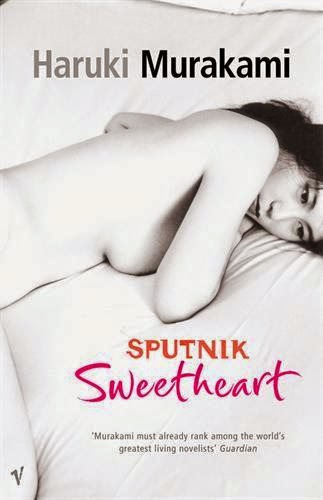
Book 11: Sputnik Sweetheart by Haruki Murakami
Title: Sputnik Sweetheart
Author: Haruki Murakami
Length: 210 pages
Year Written: 1999
Why I chose this book: I really enjoy Murakami. I bought this book in September 2012 and never finished it until now. The receipt from Barnes and Noble was still inside.
This book is so Murakami. You can spot Murakami a mile away. If you've read one of his novels, you've read most of his novels — and I don't mean that in a bad way. The first two books I read by Murakami were After Dark and Hardboiled Wonderland and the End of the World, for an Asian-American literature class I took during my senior year of college. These two were OK but I wasn't truly blown away until I read South of the Border, West of the Sun. Murakami really knows how to write about passion without sounding corny or overwrought with dramatic desire. Then, I read Kafka on the Shore, which showed a more complex and supernatural side of Murakami. Anyway, on to the book at hand — Sputnik Sweetheart shares many of the same themes as several of Murakami's other novels, including weird Freudian love triangles and escape into other-wordly realms. It is about a girl named Sumire who falls in love with an older woman, Miu, and eventually vanishes seemingly right off the face of the earth. The book is told from the perspective of Sumire's friend, a relatively easygoing guy who happens to be madly in love with her.
This was a really quick read, being just north of 200 pages and so engagingly written as well. It certainly provoked a lot of thought with me, about loneliness, love, desire, human existence, all those things that leave you feeling mildly panicked if you dwell on them too long.
Rating: 9.5/10
Thursday, April 3, 2014
Book 10: A Spy in the House of Love by Anaïs Nin
Title: A Spy in the House of Love
Author: Anaïs Nin
Length: 140 pages
Year Written: 1954
Why I chose this book: I purchased this book when I was 18 or 19, purely based on the feeling I got from the title and back cover description.
I once read a quote by Anaïs Nin that gave me an incredible sense of oneness with her: "If you do not breathe through writing, if you do not cry out in writing, or sing in writing, then don't write, because our culture has no use for it."
I have owned by copy of 'A Spy in the House of Love' for at least six years. It is water-warped and has a brown coffee-ish stain creeping down its slim paper side. I had no idea what the book was really about until I picked it up this year. Most importantly, it is book four of a five-part "continuous novel" called 'Cities of the Interior.' If I'd known that, I'd certainly have started at one, or not started at all. However, this small novel in itself is dreamy, emotional, and strangely moving.
The idea of infidelity in relationships being perpetrated by the girl — it's something I don't often see. It's something I can identify with personally, having been torn between different perceptions of myself that were based on dishonorable acts in love. We rarely get to see inside the head of a woman who is obviously smart, obviously wonderful in all ways except her ability to contain her love within the framework of a nice, faithful, cookie-cutter companion. Because these books are "distillations" of Nin's personal diaries, it is easy to imagine that much of her personal life flowed into this story. I can only wonder what percentage is drawn purely from imagination. Her words are poetic, strong, sometimes racist (but I guess that's unintentional, and indicative of her time - oh well). It was a very short novel, and explores themes like love, respect, guilt, and identity. I would love to read the other four parts of 'Cities,' but mostly I want to learn more about Nin.
Rating: 7.6/10
Author: Anaïs Nin
Length: 140 pages
Year Written: 1954
Why I chose this book: I purchased this book when I was 18 or 19, purely based on the feeling I got from the title and back cover description.
I once read a quote by Anaïs Nin that gave me an incredible sense of oneness with her: "If you do not breathe through writing, if you do not cry out in writing, or sing in writing, then don't write, because our culture has no use for it."
I have owned by copy of 'A Spy in the House of Love' for at least six years. It is water-warped and has a brown coffee-ish stain creeping down its slim paper side. I had no idea what the book was really about until I picked it up this year. Most importantly, it is book four of a five-part "continuous novel" called 'Cities of the Interior.' If I'd known that, I'd certainly have started at one, or not started at all. However, this small novel in itself is dreamy, emotional, and strangely moving.
The idea of infidelity in relationships being perpetrated by the girl — it's something I don't often see. It's something I can identify with personally, having been torn between different perceptions of myself that were based on dishonorable acts in love. We rarely get to see inside the head of a woman who is obviously smart, obviously wonderful in all ways except her ability to contain her love within the framework of a nice, faithful, cookie-cutter companion. Because these books are "distillations" of Nin's personal diaries, it is easy to imagine that much of her personal life flowed into this story. I can only wonder what percentage is drawn purely from imagination. Her words are poetic, strong, sometimes racist (but I guess that's unintentional, and indicative of her time - oh well). It was a very short novel, and explores themes like love, respect, guilt, and identity. I would love to read the other four parts of 'Cities,' but mostly I want to learn more about Nin.
Rating: 7.6/10
Sunday, March 23, 2014
Book 9: Persuasion by Jane Austen
Title: Persuasion
Author: Jane Austen
Length: 188 pages
Year Written: 1818
Why I chose this book: 'Persuasion' was a favorite of the protagonist in Chuck Palahniuk's books Damned and Doomed, which I read (and loved).
I "read" 'Pride and Prejudice' during my junior year of high school. I couldn't remember if I actually tried to read it and couldn't, or if I was just being a lazy asshole. When I was reminded of Jane Austen while reading another book recently (where the 13-year-old dead girl Maddy Spencer adores 'Persuasion'), I added it to my reading queue. What a mistake. I must still be an asshole, because I oh-so-barely enjoyed this novel. Even at under 200 pages, it took me a while to finish - and not for lack of trying. The language is difficult, but not the oldest writing style I've encountered this far in my bookventures. The plot is very slow, very dry, and very detailed about mundane minutiae. I actually had to look up why this book, and Austen herself, is considered so great. I know the issue lies with me, and not the book itself. I've got to pay respect. It just wasn't for me in the least bit.
I did, however, find a great review that explains what it is this book does so well, that everyone else in the world besides me seems to love: http://www.bookdrum.com/books/persuasion/9780141439686/review.html
It's a love story, like so many books are, and I can't say the end was surprising or very satisfying at all. It ends happily, but didn't make me happy. Maybe I've got to wait another eight years to take a stab at Austen appreciation.
Rating: 2/10
Author: Jane Austen
Length: 188 pages
Year Written: 1818
Why I chose this book: 'Persuasion' was a favorite of the protagonist in Chuck Palahniuk's books Damned and Doomed, which I read (and loved).
I "read" 'Pride and Prejudice' during my junior year of high school. I couldn't remember if I actually tried to read it and couldn't, or if I was just being a lazy asshole. When I was reminded of Jane Austen while reading another book recently (where the 13-year-old dead girl Maddy Spencer adores 'Persuasion'), I added it to my reading queue. What a mistake. I must still be an asshole, because I oh-so-barely enjoyed this novel. Even at under 200 pages, it took me a while to finish - and not for lack of trying. The language is difficult, but not the oldest writing style I've encountered this far in my bookventures. The plot is very slow, very dry, and very detailed about mundane minutiae. I actually had to look up why this book, and Austen herself, is considered so great. I know the issue lies with me, and not the book itself. I've got to pay respect. It just wasn't for me in the least bit.
I did, however, find a great review that explains what it is this book does so well, that everyone else in the world besides me seems to love: http://www.bookdrum.com/books/persuasion/9780141439686/review.html
It's a love story, like so many books are, and I can't say the end was surprising or very satisfying at all. It ends happily, but didn't make me happy. Maybe I've got to wait another eight years to take a stab at Austen appreciation.
Rating: 2/10
Thursday, March 13, 2014
Book 8: This Is How You Lose Her by Junot Diaz
Title: This Is How You Lose Her
Author: Junot Diaz
Length: 217 pages
Year Written: 2012
Why I chose this book: This was a birthday gift from another of my book club ladies, Bess (this actually rounds out the birthday-given book collection)!
This was the perfect book to make up for the sluggish pace with which I read the last one. I finished this one in two to three sittings, max. The language is so engaging, so easy to ingest. I'm also glad to have read a second book by Junot Diaz—it's always great to read multiple books by the same author. There tend to be themes that reappear throughout an author's collection of works. Diaz is certainly no exception.
Much like The Brief Wondrous Life of Oscar Wao, the main characters are Dominican. There is again a Yunior (who some say is a novelized representation of the author himself that he uses in more than one book). There is again a weaving of narratives that portray doomed relationships, family strain, and sexual escapades. This book, written five years after Wao, is more bare-bones, more focused on smaller-scale stories that still mightily represent the human experience. The book's central theme is infidelity, and we see both how a string of relationship fuck-ups dented the main character's life, and how it seems like it was in his blood for him to fuck up as horribly and frequently as he did.
There is something we can all relate to in this book, whether it is trudging through difficult post-infidelity reconciliations, or reminiscing on the struggles of a trying childhood. Lots of people told me I'd love this book, and I'm glad to say that's absolutely the truth.
Rating: 9.5/10
Author: Junot Diaz
Length: 217 pages
Year Written: 2012
Why I chose this book: This was a birthday gift from another of my book club ladies, Bess (this actually rounds out the birthday-given book collection)!
This was the perfect book to make up for the sluggish pace with which I read the last one. I finished this one in two to three sittings, max. The language is so engaging, so easy to ingest. I'm also glad to have read a second book by Junot Diaz—it's always great to read multiple books by the same author. There tend to be themes that reappear throughout an author's collection of works. Diaz is certainly no exception.
Much like The Brief Wondrous Life of Oscar Wao, the main characters are Dominican. There is again a Yunior (who some say is a novelized representation of the author himself that he uses in more than one book). There is again a weaving of narratives that portray doomed relationships, family strain, and sexual escapades. This book, written five years after Wao, is more bare-bones, more focused on smaller-scale stories that still mightily represent the human experience. The book's central theme is infidelity, and we see both how a string of relationship fuck-ups dented the main character's life, and how it seems like it was in his blood for him to fuck up as horribly and frequently as he did.
There is something we can all relate to in this book, whether it is trudging through difficult post-infidelity reconciliations, or reminiscing on the struggles of a trying childhood. Lots of people told me I'd love this book, and I'm glad to say that's absolutely the truth.
Rating: 9.5/10
Subscribe to:
Posts (Atom)